


Blogs
The Buddhist Prayer Wheel: A Simple Path to Peace and Positivity

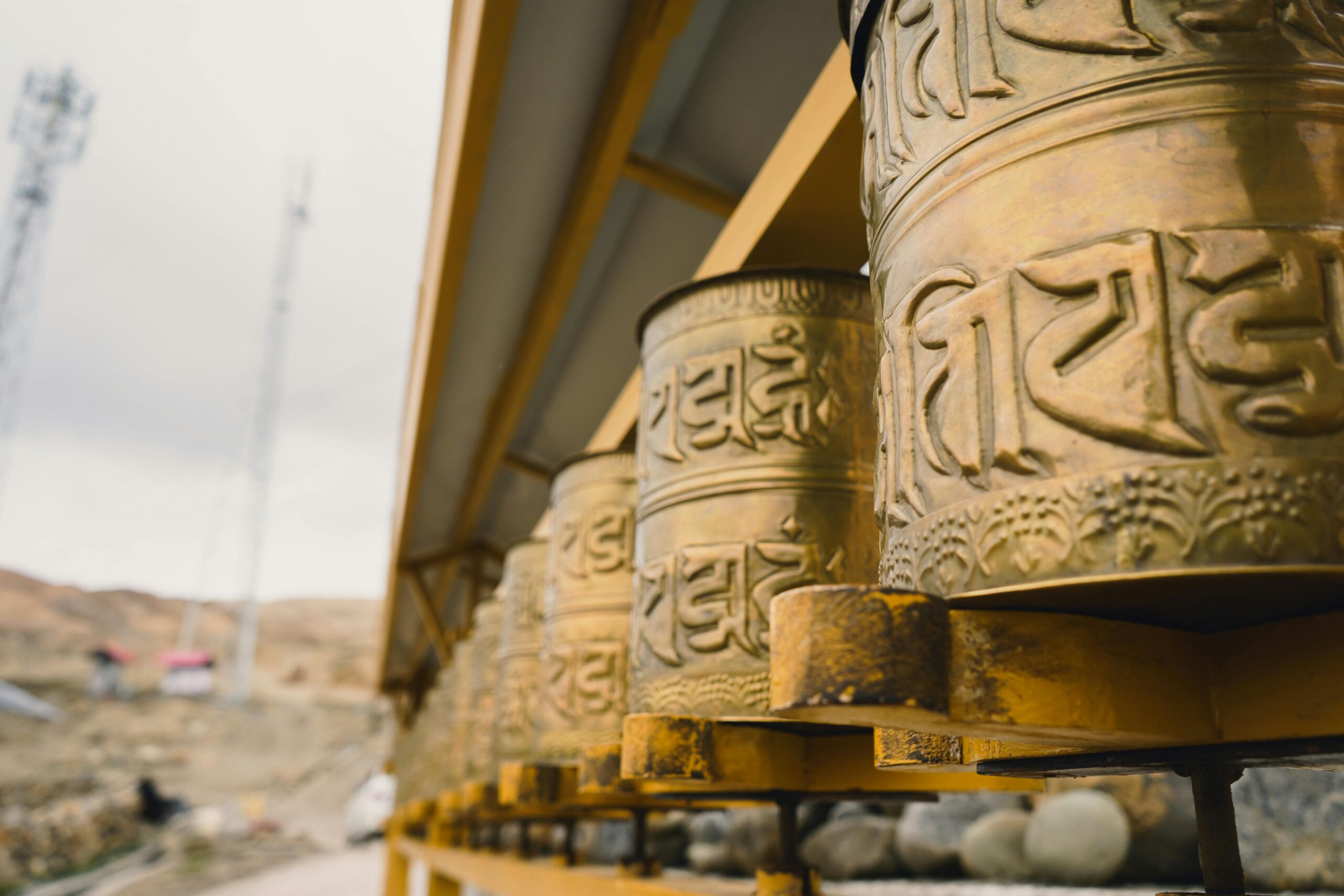
Have you ever seen a wheel gently spinning in a monastery or someone’s home and wondered what it means? That’s a prayer wheel.
A Buddhist prayer wheel (Tibetan: mani khorlo) is a rotating cylindrical drum, filled with rolled sheets of printed mantras, that is spun clockwise to spread blessings, purify karma, and accumulate spiritual merit each turn believed to be equal to reciting every mantra sealed inside it, once.
That’s a Buddhist prayer wheel, a sacred symbol of peace, compassion, and spiritual awakening—deeply rooted in Tibetan Buddhism.
At Swodeshi.com, we bring this ancient wisdom into your daily life with handheld and table prayer wheels, crafted with care in Nepal. More than a spiritual artifact, the prayer wheel is a tool for mindfulness, healing, and energy, something our busy lives can truly benefit from.
What is a Prayer Wheel?
Origin: From the Himalayas to Your Home
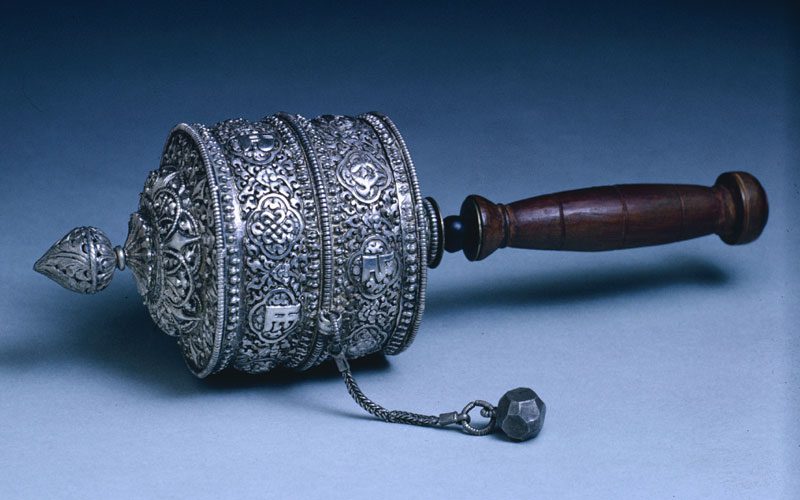
The prayer wheel’s roots run deep into the history of Vajrayana (Tantric) Buddhism.
The prayer wheel originated in Tibet, where it became a key part of Vajrayana Buddhist practice. Inside each wheel are sacred mantras—most commonly “Om Mani Padme Hum”—written thousands or even millions of times. Instead of chanting them aloud, spinning the wheel is believed to release their blessings and merit into the world.
Earliest Recorded Use
Wind-powered prayer wheels have been documented in Tibet and China as far back as the 4th century CE, making the prayer wheel one of the oldest surviving devotional technologies still in everyday use today.
The Legendary Lineage
Tibetan tradition traces the origin of the prayer wheel practice back to the great Indian master Nagarjuna. Later Indian masters Tilopa and Naropa, and their Tibetan successors Marpa and Milarepa, are also credited with transmitting and popularizing the practice within the Tibetan Buddhist lineages.
From Revolving Scripture Cabinets to Mantra Mills
One scholarly theory holds that the physical design of the Tibetan prayer wheel evolved from revolving octagonal bookcases used in early Chinese Buddhist monasteries to store sacred scriptures. Spinning these cabinets was believed to generate merit equivalent to reading the entire Buddhist canon. Over centuries, this idea was refined in Tibet into the compact, personal, mantra-filled cylinder recognized today — while still symbolically echoing the Buddha’s first sermon, known as the “Turning of the Wheel of the Dharma.”
The prayer wheel spread from Tibet throughout the wider Himalayan region — including Nepal, Bhutan, and Mongolia — becoming a fixture of everyday devotional life for monks and laypeople alike.
This way, even a layperson or someone unfamiliar with mantras can participate in spiritual practice meaningfully and powerfully.
Wisdom from the Himalayas: Body, Speech & Mind

As taught by a respected Tibetan Rinpoche, spinning a prayer wheel brings together:
- Virtue of the body: the physical act of spinning moves countless mantras.
- Virtue of speech: the power of inner mantras makes offerings to enlightened beings and purifies negativities.
- Virtue of the mind: the act focuses your attention, cultivating a calm and undistracted state.
“Even a single moment of spinning with a pure heart has vast benefit,” the Rinpoche reminds us.
When done with the intention to benefit all beings, you activate bodhichitta—the union of compassion and wisdom.
Anatomy of a Prayer Wheel
Every prayer wheel, from a simple handheld version to an elaborate temple installation, shares the same core structure:
| Part | Function |
|---|---|
| Cylinder (drum) | Houses the mantra scroll; typically made of metal, wood, conch shell, or stone |
| Mantra scroll | A tightly rolled strip of paper printed with the mantra thousands to millions of times the “power source” of the wheel |
| Central axle (“life tree”) | A wood or metal rod running through the core of the cylinder, around which the scroll is wound |
| Handle | Allows the wheel to be gripped and rotated by hand |
| Counterweight and chain | A small weighted chain attached to the cylinder acts as a governor, helping the wheel spin smoothly with minimal wrist effort |
| Outer inscriptions | The cylinder’s exterior is often engraved with Om Mani Padme Hum in ornamental Lantsa (Ranjana) script, along with auspicious Buddhist symbols |
How to Use a Prayer Wheel (Step-by-Step)
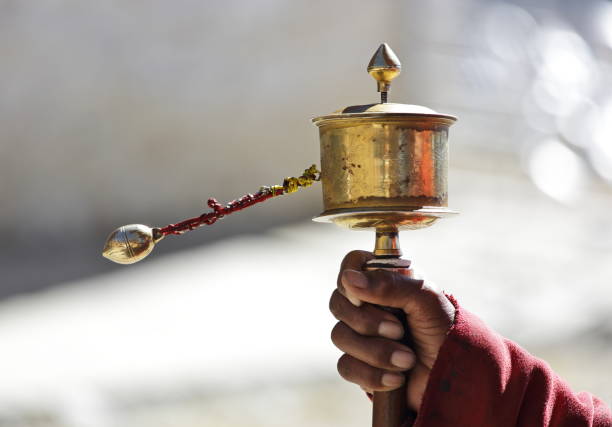
Tibetan prayer wheel in the hand
Using a prayer wheel is simple but spiritually profound.
- Hold the wheel in your right hand, keeping the cylinder upright.
- Spin clockwise, following the same direction as the sun’s movement across the sky and the direction in which the mantras are written.
- Focus your mind on compassion, healing, or peaceful thoughts.
- Optionally, chant or silently repeat “Om Mani Padme Hum” as you spin.
- Spin with grace and mindfulness — not quickly or carelessly.
This ritual becomes a moving meditation: a way of aligning body, speech, and mind with positive intention. Traditionally, at the end of a practice session, any merit generated is mentally dedicated to the benefit of all beings a small but meaningful gesture that turns a personal practice into an act of generosity.
Types of Prayer Wheels
At Swodeshi.com, we offer two meaningful and functional types:
- Handheld Prayer Wheels: Ideal for personal use—small, light, and portable. Use it while walking, meditating, or anytime you need calm.
- Table Prayer Wheels: Designed for placement in your home, office, or sacred space. These can be gently spun throughout the day to maintain a flow of positive energy.
Other traditional types include:
- Large temple wheels in monasteries
- Water-powered or wind-powered wheels, found in nature
- Digital prayer wheels for modern seekers
But for daily life, handheld and table wheels are the most practical and accessible.
The Dharma Wheel vs. the Prayer Wheel — Don’t Confuse Them
These two symbols are related but not the same thing, and it’s a common point of confusion:
- The Dharmachakra (“Wheel of Dharma”) is a static symbol — an eight-spoked wheel representing the Noble Eightfold Path and the spread of the Buddha’s teachings.
- The prayer wheel (mani khorlo) is a physical, functional ritual object that a person actually spins to generate merit.
Think of the Dharmachakra as a symbol of the teaching, and the prayer wheel as a tool for practicing it.
Where to Place a Prayer Wheel
- Handheld Prayer Wheel: Meant for your personal spiritual journey. Carry it in your bag, place it on your desk, or take it on a walk. Perfect for private practice anytime, anywhere.
- Table Prayer Wheel: Best placed in shared or calm spaces like:
- Your living room – radiates peace for your family and guests
- Office desk – brings clarity during stressful workdays
- Reception or lobby – creates a welcoming and blessed environment
Every spin becomes a quiet blessing—not just for you, but for everyone around you.
How to Choose a Prayer Wheel
With so many styles available, choosing the right one comes down to how — and where — you plan to use it.
Handheld vs. Table: Which Is Right for You?
Choose a handheld wheel if you want a personal, portable practice — something to spin during a walk, at your desk between tasks, or while traveling. Choose a table wheel if you want a shared focal point for a room: a living space, office, or entryway where the wheel can be spun by anyone who passes.
Materials Guide
- Metal (copper, brass, silver-plated) — traditional, durable, and often engraved with mantras or auspicious symbols
- Wood — lighter and warmer in feel, common for handheld personal practice
- Gemstone-inlaid — turquoise, coral, or semi-precious stone detailing, often reflecting the more ornate wheels historically made for lamas and patrons
What to Look for in an Authentic, Nepal-Made Prayer Wheel
Look for a wheel with a properly wound mantra scroll (not a decorative shell), a smooth-spinning axle with a counterweight for effortless rotation, and clear, legible mantra script on the exterior. Handcrafted wheels made in Nepal where the tradition remains a living daily practice — carry an authenticity that mass-produced imitations don’t.
Prayer Wheels in Nepal Today
Nepal remains one of the living centers of this tradition. At Kathmandu’s Swayambhunath and Boudhanath stupas, rows of fixed prayer wheels line the circumambulation paths, spun continuously by pilgrims and visitors throughout the day. Along Himalayan trekking routes — including trails through the Annapurna and Everest regions handheld and mounted wheels appear at monasteries, chortens, and mani walls, marking the path for trekkers and devotees alike. Some monasteries in the wider Himalayan region maintain kora paths lined with prayer wheels stretching several kilometers, forming a walking meditation that can take pilgrims hours to complete.
This living context is part of why a prayer wheel handcrafted in Nepal carries a different weight than a decorative import it comes from a place where the practice never stopped.
Prayer Wheel in Real Life: Simple Moments, Deep Impact
Here are a few real-life ways to integrate a prayer wheel into your daily routine:
- Feeling overwhelmed at work? A short pause to spin the table wheel can restore calm and focus. It gently shifts the energy of your space and even lifts the mood of those nearby.
- At home, it can be a centerpiece that invites peace and reflection—benefiting family members and even guests.
- During meditation or prayer, it helps deepen your concentration and intention.
- Many also spin it silently before starting a project or making a decision, using it as a tool for clarity and guidance.
Scientific and Emotional Benefits
Modern science shows that repetitive actions—like spinning a wheel—have similar effects to meditation:
- Reduces stress and anxiety
- Enhances focus and mindfulness
- Encourages a calmer, more compassionate mindset
You don’t need to be a monk to feel its impact. Just spin with intention, and let the movement become a moment of peace.
Lessons from the Buddhist Prayer Wheel
- Small actions matter: Repetition builds inner strength.
- Move with purpose: Your intention shapes your reality.
- Let go: Like the spinning wheel, life keeps turning.
- Act for others: The most meaningful practice is the one that benefits all.
Final Thought: A Spin Toward Harmony
The prayer wheel may be ancient, but its message is timeless. Whether you choose a handheld wheel for personal use or a table wheel for your home or office, each spin becomes a symbol of hope, healing, and compassion.
At Swodeshi.com, we honor this tradition with carefully crafted prayer wheels made in Nepal, so you can bring this sacred practice into your everyday life.
FAQ on Buddhist Prayer Wheel
1. What is a prayer wheel used for?
A prayer wheel is used to accumulate spiritual merit and purify negative karma. Its cylinder holds a scroll printed with mantras, usually “Om Mani Padme Hum.” Spinning it clockwise is believed to release the blessing of every mantra inside, once per turn, making it a physical tool for devotion and mindfulness.
2. What does spinning a prayer wheel do?
Spinning activates the mantras sealed inside the drum. Each clockwise rotation is considered spiritually equivalent to reciting all the enclosed mantras at once, generating merit, purifying karma, and radiating blessings outward — turning physical motion into a form of devotional practice.
3. What is the meaning of a Tibetan prayer wheel?
Called mani khorlo in Tibetan, it combines “mani” (wish-fulfilling jewel, from Sanskrit cintamani), “chos” (dharma/teaching), and “khorlo” (wheel or cycle). It represents the turning of the Buddha’s teachings, and functions as a mechanical means of spreading compassion and wisdom.
4. What is written inside a prayer wheel?
Inside is a tightly rolled paper scroll printed with sacred mantras — most commonly “Om Mani Padme Hum” repeated thousands or even millions of times. This scroll is wound around a central axle, sometimes called the “life tree,” which runs through the core of the cylinder.
5. What does “Om Mani Padme Hum” mean?
It’s a Sanskrit mantra invoking Avalokiteshvara, the bodhisattva of compassion, and is often translated loosely as “the jewel in the lotus.” Its six syllables are traditionally linked to purifying the six realms of existence and cultivating compassion, wisdom, and generosity.
6. Why do Buddhists spin prayer wheels instead of just chanting?
Spinning makes the practice accessible to everyone, including those who don’t know Tibetan or Sanskrit or haven’t memorized the mantras. It brings together the body (motion), speech (the mantra’s power), and mind (focused intention), so a person can participate meaningfully without spoken recitation.
7. Is a prayer wheel the same as a Dharma wheel?
No. The Dharmachakra (“Wheel of Dharma”) is a static eight-spoked symbol representing the Noble Eightfold Path and Buddha’s teachings. A prayer wheel (mani khorlo) is a physical object you actually spin to generate merit. One is a symbol; the other is a functional ritual tool.
8. What religion uses prayer wheels?
Prayer wheels are a practice within Vajrayana (Tantric) Buddhism, most closely associated with Tibetan Buddhism. They’re used throughout the Himalayan region, including Tibet, Nepal, Bhutan, and Mongolia, by monks and laypeople alike.
9. Which direction do you spin a prayer wheel clockwise or counterclockwise?
Always clockwise. This follows the sun’s movement across the sky and matches the direction in which the mantras are written inside the scroll, which is considered essential to the practice.
10. How many times should you spin a prayer wheel?
There’s no fixed number the tradition emphasizes sincerity over quantity. Even a single rotation done with a pure, focused intention is considered meaningful; longer sessions during meditation simply extend that same focused practice.
11. Do you have to hold a prayer wheel in your right hand?
Traditionally, yes. The wheel is held upright in the right hand and spun with a gentle wrist motion, while the mind stays focused on compassion, healing, or peace.
12. Can you spin a prayer wheel with your left hand?
Tradition specifies the right hand as the standard practice. If the right hand isn’t usable, the sincerity and clockwise direction of the spin matter more than which hand is used the source material doesn’t treat this as a strict prohibition, but the right hand remains customary.
13. What do you think about while spinning a prayer wheel?
Practitioners focus on compassion, healing, or peaceful thoughts, often silently repeating “Om Mani Padme Hum.” The goal is to align body, speech, and mind, and many dedicate any merit generated to the benefit of all beings at the end.
14. Do you need to chant while spinning it, or is spinning alone enough?
Chanting is optional. Spinning alone with sincere intention is considered meaningful practice, since the mantras are “activated” through the motion itself rather than through spoken recitation.
15. Is it disrespectful to spin a prayer wheel fast?
Traditional guidance calls for spinning with grace and mindfulness, not quickly or carelessly. A hurried, careless spin is seen as missing the point of the practice, which centers on calm, focused intention rather than speed.
16. What happens if you spin a prayer wheel the wrong way?
Spinning counterclockwise goes against the mantra’s written orientation and the sun’s natural direction, so it’s considered to go against traditional practice. Practitioners are simply guided to reset and continue spinning clockwise going forward.
17. Can non-Buddhists use a prayer wheel?
Yes. Anyone can use a prayer wheel regardless of religion or background it’s considered a tool for inner peace and mindfulness open to all, not something restricted to practicing Buddhists.
18. Is it cultural appropriation to own a prayer wheel if you’re not Buddhist?
This is a matter of ongoing debate rather than settled fact. Many teachers frame prayer wheels as tools open to anyone practicing with sincerity and respect; others emphasize understanding and honoring the tradition’s origins and meaning rather than treating it as mere decor. Approaching it thoughtfully learning its history and purpose is generally the more respectful path.
19. Do prayer wheels actually work, or is it just symbolic?
This depends on one’s belief system. Within the tradition, spinning is held to generate real spiritual merit. Separately, modern research on repetitive, meditative actions suggests they can reduce stress and improve focus a benefit that doesn’t require accepting the traditional spiritual claims.
20. Is spinning a prayer wheel considered “cheating” at prayer?
No within the tradition it’s not seen as a shortcut but as its own legitimate practice, making devotion accessible to those who don’t know the mantras by heart or aren’t fluent in Tibetan or Sanskrit.
21. Do prayer wheels need to be blessed or consecrated before use?
The source material doesn’t specify a required consecration step for personal handheld or table wheels. Many practitioners do seek a blessing from a teacher or lama for significant or temple wheels; for personal daily practice, sincere intention during use is the emphasized element.
22. Where is the best place to put a prayer wheel in your house?
A living room works well for radiating peace to family and guests, while a desk or entryway keeps it accessible for daily spins. The key is choosing a calm space where it can be spun regularly and treated with respect.
23. Can you keep a prayer wheel in your bedroom?
The source material doesn’t give a specific rule against this. Many people keep a personal handheld wheel wherever they practice or find calm, including a bedside table, though shared spaces like a living room are more commonly recommended for table wheels.
24. Is it okay to put a prayer wheel on the floor?
As a sacred object, a prayer wheel is generally treated with the same respect given to other devotional items kept on a clean, elevated surface such as a table or shelf rather than the floor.
25. Does a solar-powered prayer wheel actually work, or is it just decorative?
Traditional continuously-turning wheels include wind- and water-powered versions, so a mechanically-turning solar wheel fits that same category of “self-spinning” wheels. Whether continuous mechanical rotation carries the same significance as an intentional hand spin is a matter of personal or teacher interpretation.
26. How do you clean or maintain a prayer wheel?
Keep the exterior dust-free with a soft, dry cloth, and avoid harsh chemicals that could damage engravings or gemstone inlays. Check periodically that the axle spins smoothly and the counterweight chain is intact, since these keep the wheel turning with minimal effort.
27. What’s the difference between a handheld and a table prayer wheel?
A handheld wheel is small, light, and portable ideal for personal use while walking, traveling, or meditating. A table wheel is larger and meant to stay in a home, office, or shared space, spun by anyone who passes throughout the day.
28. Is it okay to give a prayer wheel as a gift?
Yes, prayer wheels are commonly given as meaningful gifts. Since anyone can use one regardless of background, it can be a thoughtful way to offer someone a tool for calm, mindfulness, and positive intention.
29. How do you know if a prayer wheel is authentic vs. mass-produced?
Look for a properly wound mantra scroll inside (not just a decorative shell), a smooth-spinning axle with a counterweight, and clear, legible mantra script on the exterior. Wheels handcrafted in Nepal, where the tradition remains a living daily practice, carry an authenticity mass-produced imitations typically lack.
30. How much does a genuine Tibetan/Nepali prayer wheel cost?
Pricing varies by size, material, and craftsmanship simple wood or metal handheld wheels cost less, while gemstone-inlaid or silver-plated pieces cost more. Check current pricing directly with the retailer, since it depends on materials and the intricacy of the scroll and engravings.
