


Handmade Singing Bowls from Nepal | Starting NPR 1,500
Every singing bowl in this collection is sourced directly from artisan families in the Kathmandu Valley hand-hammered and machine-made, hand-tested for tone, and shipped worldwide. Whether you’re building a meditation practice, exploring sound healing, or choosing a meaningful gift, you’ll find the right bowl here.
Singing bowl from Nepal, immerse yourself in the enchanting world of each, a testament to centuries-old craftsmanship and spiritual connection.
Crafted with care, our singing bowl embodies the rich heritage shared between Nepal and Tibet, resonating with soothing tones and profound significance.
Explore our diverse range, from meticulously handmade bowls infused with artisanal charm to machine-crafted wonders ensuring consistent quality.
Each design tells a story, from the tranquil allure of the full moon bowl to the invigorating symbolism of the 7 Chakra bowl, adorned with sacred motifs like Buddha, Lotus, and Om Mane Peme Hum.
Whether you seek solace after a hectic day, deepen your meditation practice, or enhance your yoga sessions, our singing bowls offer a gateway to inner peace and balance.
Hand-in-hand with local artisans, we bring you the finest quality, ensuring every bowl is a masterpiece of precision and passion.
Experience the magic firsthand – let our singing bowl transform your space into a sanctuary of serenity. Whether for yourself, your cherished pet, or a loved one, our singing bowls are a timeless gift of tranquility and harmony.
Start your journey today – browse our collection and embrace the essence of Nepal’s ancient tradition.
Don't delay; commence your odyssey towards inner harmony now!
Let the singing bowl be your conduit to mental serenity, your pet’s sanctuary, or a heartfelt gift for cherished individuals. Explore our collection and bring the magic of Nepal home today!
Showing all 6 results

5.5″ Beaten Singing Bowl
NPR 1,512Specification:
Dimension: Height-3″; Length-5.5 “; Breadth-5.5 ”
Weight: 700 gm

6.2″ Buddha Prayer Words Singing Bowl
NPR 3,520Specification:
Dimension: Height-3.3 “; Length-6.2 “; Breadth-6.2 ”
Weight: 900 gm

7.2″ Etching Singing Bowl – Handmade
NPR 5,976Specification:
Dimension: Height-3.7″; Length-7.2 “; Breadth-7.2 ”
Weight: 830 gm

7.5″ Matt Singing Bowl – Handmade
NPR 8,800Specification:
Dimension: Height-3.1 “; Length-7.5 “; Breadth-7.5 ”
Weight: 930 gm
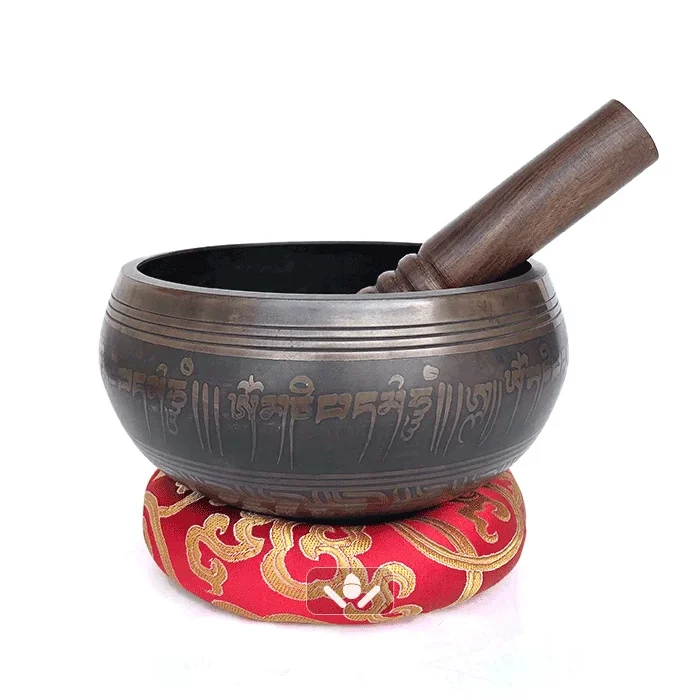
7.6″ Brown Singing Bowl – Handmade
NPR 7,200Specification:
Dimension: Height-3.6 “; Length-7.6 “; Breadth-7.6 ”
Weight: 1000 gm

7″ Tiger Singing Bowl – Handmade
NPR 5,440Specification:
Dimension: Height-3.5″; Length-7.5″; Breadth-7.5″
Weight: 850 gm
Authentic Handmade Tibetan Singing Bowls From Nepal| Best Tibetan Singing Bowls
Discover authentic handmade Tibetan singing bowls crafted by skilled artisans in Nepal. Made using traditional Himalayan techniques, our singing bowls are designed for meditation, mindfulness, yoga, sound healing, and spiritual practices.
A Tibetan singing bowl is a metal resonance bowl traditionally associated with the Himalayan regions of Nepal, Tibet, and Northern India. Known for producing rich harmonic tones and long-lasting vibrations, these bowls are widely used for relaxation, chakra balancing, energy work, and Buddhist rituals.
At Swodeshi, we offer a carefully curated collection of handcrafted and machine-made singing bowls, including traditional 7-metal singing bowls made in Nepal. Every bowl reflects generations of Nepalese craftsmanship and cultural heritage, making it suitable for beginners, meditation practitioners, yoga teachers, sound healers, and collectors.
Whether you are looking to buy an authentic Tibetan singing bowl for meditation, sound therapy, chakra work, or spiritual practice, explore our collection of original Nepal-made singing bowls available for worldwide delivery.
Singing Bowls From Nepal in Swodeshi with Prices
| Product Name | Size | Description | Price (NPR) |
|---|---|---|---|
| 6.2″ Buddha Prayer Words Bowl | 15.748 cm | Hand-hammered, Tibetan script | 3,520 |
| 5.5″ Beaten Singing Bowl | 13.97 cm | Handmade, etched Tibetan design | 1,512 |
| 7.2″ Etching Singing Bowl | 18.288 cm | Handmade, etched sacred symbols | 5,976 |
| 7.5″ Matt Singing Bowl | 19.05 cm | Plain, hand-hammered finish | 8,800 |
| 7″ Tiger Singing Bowl | 17.78cm | Traditional handcrafted Tibetan bowl | 5,440 |
| 7.6″ Brown Singing Bowl | 19.304 cm | Etched with Tibetan mantra design | 7,200 |
Singing bowl price in Nepal generally ranges from NPR 500 to NPR 25,000+, depending on size, craftsmanship, and the metals used. Handmade and antique bowls tend to sit at the higher end because of the time and skill involved.
What is a Singing Bowl?
Singing bowls have different names, such as Tibetan Singing bowl, meditation bowl, chakra healing bowl, 7 metal bowl, and other various names.
Simply, the singing bowl is that bowl which produces a sustained and deep sound, which makes your body and mind heal from anxiety, tension, and other consequences.
7 Metal Singing Bowl
Generally, the singing bowl is made from the 7 metal. The composition of 7 metals in singing bowls is:
- Gold
- Silver
- Mercury
- Copper
- Iron
- Tin
- Lead
Here, the representation of the 7 metals is:
- Gold: which is the symbol for the Sun and for the chakra Crown chakra of the body
- Silver: which is the symbol of the Moon, is for the Third Eye chakra
- Mercury: which symbolizes Mercury, is for the Throat Chakra
- Copper: which symbolizes Venus, is for the Heart Chakra
- Iron: which symbolizes Mars, is for the Solar Plexus Chakra
- Tin: which symbolizes Jupiter, is for the Sacral Chakra
- Lead: which symbolizes Lead, is for the Root Chakra
The Science Behind the Singing Bowl
How Sound Is Produced: Friction and Vibration
To play a singing bowl, one must either strike the bowl or rub the rim with a mallet. The friction created either by rubbing or striking a singing bowl creates vibrations. These vibrations create the sound we hear and can feel when holding the singing bowl. As you continue to rub the rim of the bowl, the friction keeps the sound going. This is called resonance — the note we hear even after the player ceases contact between the singing bowl and the mallet.
Most important is the sound-producing technique used, either impacting or rubbing, or both simultaneously, as well as the excitation location, the hardness and friction characteristics of the exciting stick (called puja, frequently made of wood and eventually covered with a soft skin).
Vibrational Modes: What Experiments Revealed
Researchers Octávio Inácio, Luís Henrique, and José Antunes conducted detailed experimental modal analyses on multiple bowls of different sizes. Their findings, published in The Dynamics of Tibetan Singing Bowls, showed the following:
Results from experiments on three bowls show the existence of 5 to 7 prominent resonances with very low modal damping values up to frequencies of about 4–6 kHz. The shapes of the identified bowl modes are mainly due to bending waves that propagate azimuthally, resulting in patterns similar to some modeshapes of bells. Modal frequencies are roughly proportional to 2j and inversely proportional to the square of the bowl's diameter.
Despite the high manufacturing quality of these handcrafted instruments, perfect axi-symmetry is nearly impossible to achieve. These slight geometric imperfections lead to the existence of two orthogonal modes with slightly different natural frequencies. Although this is not always apparent, an apparently single resonance often reveals two closely spaced peaks upon closer analysis.
For the listener, rubbed bowls behave as spinning quadrupoles or, in general, 2j-poles depending on the self-excited mode and the radiated sound will always be perceived with beating phenomena, even for a perfectly symmetrical bowl.
How the Playing Technique Affects the Sound
The normal contact force FN and the tangential rubbing velocity VT of the puja are the most relevant factors which allow the musician to play the instrument and control the mechanism of sound generation. Many distinct sounds may be obtained by changing them.
Three distinct motion regimes were identified depending on these playing parameters:
Steady self-excited vibration with permanent contact between the puja and the bowl; steady self-excited vibrations with periodic contact disruption; and unsteady self-excited vibrations with intermittent amplitude increasing followed by attenuation after chaotic chattering. The first motion regime offers the "purest" bowl singing. Higher values of normal force should enable a better control of the produced sounds, as they lead to shorter transients and render the system less prone to chattering.
Playing experience shows that rubbing with pujas made of different materials may trigger self-excited motions at different fundamental frequencies. This suggests that friction and contact parameters have an important influence on the dynamics of the bowl regimes.
The Role of Water: Faraday Waves and Droplet Generation
One of the most extensively studied aspects of singing bowls is what happens when they are filled with water and played. The key peer-reviewed study here is by Denis Terwagne (Université de Liège) and John W. M. Bush (MIT), published in Nonlinearity in 2011.
Striking or rubbing a fluid-filled bowl excites wall vibrations, and concomitant waves at the fluid surface. Acoustic excitation of the bowl's natural vibrational modes allows for a controlled study in which the evolution of the surface waves with increasing forcing amplitude is detailed.
When a horizontal fluid layer is vibrated vertically, its interface remains flat until a critical acceleration is exceeded. Above this threshold, a field of waves appears at the interface parametric standing waves oscillating with half the forcing frequency. The form of such Faraday waves depends on the container geometry. As the forcing acceleration is increased, progressively more complex wave patterns arise, and the interfacial dynamics become chaotic. Ultimately, large amplitude forcing leads to surface fracture and the ejection of droplets from the fluid bath.
According to Research Gate, drops may be levitated on the fluid surface, induced to bounce on or skip across the vibrating fluid surface.
The waves in Tibetan singing bowls — called edge-induced Faraday waves exhibited behavior that is "odd by any standards, even to specialists in fluid dynamics," according to Bush. At a certain point, the waves become chaotic, causing water droplets to break free and bounce on the water's surface. Bush and Terwagne found that the relatively low vibration frequency of the bowls makes them a more efficient generator of edge-induced Faraday waves and droplet generation via surface fracture.
Why the Bowl's Low Frequency Matters
A similar phenomenon exists when rubbing the edge of a wine glass, which inspired the design of the glass harmonica by Benjamin Franklin. However, the Tibetan singing bowl is easier to excite than the wine glass, since its resonant frequency is much smaller. The research on ScienceDaily shows this.
The study on thelittletibet also suggested that the metal alloys used in traditional bowls contribute to their acoustic behaviour. The material properties influence how the bowl flexes, how sound energy is distributed, and how efficiently vibrations transfer to the liquid.
Effect of Adding Water on Sound
Adding water changes the frequency of the singing bowl. The addition of water often lowers and creates a deeper, longer-lasting resonance. Water is more difficult to vibrate than the air inside an empty singing bowl, so adding water will change the note of the singing bowl.
Broader Scientific and Engineering Implications
The unique singing properties of Tibetan bowls were utilised as a way of investigating a liquid's interaction with solid materials — a situation that arises in many engineering applications such as the wind-loading of bridges and buildings. The new findings could benefit processes such as fuel injectors and perfume sprays where droplet generation plays an important role.
The study of the singing bowl's Faraday waves can actually be applied to processes such as fuel injection.
Trust Features of Swodeshi's Singing Bowl
- Handmade in Nepal, also Machine Made
- Traditional Bell Metal Bronze
- Hand-Hammered by Skilled Artisans
- Rich Harmonic Resonance
- Ethically Crafted
- Ideal for Meditation & Sound Healing
The Himalayan Tradition of Singing Bowls
The Kathmandu Valley of Nepal remains one of the most important centers of traditional singing bowl craftsmanship in the world. In historic artisan cities such as Patan and Bhaktapur, generations of metalworkers have preserved ancient bronze-working techniques that continue to shape authentic Himalayan singing bowls today.
Traditionally, singing bowls were handcrafted through repeated heating and hand-hammering processes that required extraordinary skill and patience. This labor-intensive method creates subtle variations in thickness, shape, and structure that contribute to the bowl’s unique resonance and overtone complexity.
As Buddhism spread throughout the Himalayan region, singing bowls became associated with meditation, ritual practice, and spiritual life. Over time, these bowls evolved from practical household objects into instruments deeply connected with mindfulness, sacred sound, and contemplative traditions.
Today, authentic Nepalese singing bowls continue to represent a remarkable intersection of metallurgy, craftsmanship, acoustics, and spiritual culture.
Tibetan vs crystal singing bowls
Tibetan singing bowls are hand-hammered from a metal alloy typically copper and tin, sometimes with traces of other metals, and produce a warm, complex tone with natural overtones that build as you play. Crystal singing bowls, made from quartz, deliver a cleaner, more sustained single note.
For most people, especially beginners, a Tibetan metal bowl is the more practical choice — it's durable, forgiving to play, and versatile across different uses. Crystal bowls are worth exploring if you're drawn specifically to sound healing frequencies or sustained sound baths.
Benefits of singing bowls
Singing bowls aren't a cure for anything, but most people who use them regularly notice a genuine shift in less mental noise, a quicker path to stillness, and a more grounded feeling after even a short session. Here's how people typically use them:
Meditation and mindfulness
The sound of a bowl gives your attention something concrete to follow. Instead of trying to force the mind quiet, you simply listen, and the mind tends to settle on its own. Many people find it easier to drop into meditation with a bowl than without one.
Stress and anxiety relief
Research suggests that sound-based practices can activate the parasympathetic nervous system — the body's rest response. After a few minutes with a bowl, most people feel noticeably calmer. The effect is subtle but consistent, and it doesn't require any particular belief or practice to work.
Sound healing and sound baths
Sound healers use multiple bowls together to create overlapping tones that fill a space. These sessions, often called sound baths, are deeply immersive and are used professionally in therapy settings, wellness centres, and retreat spaces. A single quality bowl is enough to begin exploring this yourself at home.
Yoga, chakra balancing, and sleep
Many yoga teachers open or close their classes with a bowl to help students arrive fully or release completely. In energy-based practices, different bowl tones are matched to different chakras — lower, deeper tones to the root, higher tones to the crown. And for sleep, a few minutes with a bowl before bed can help the body shift out of a wired state and into something quieter.
Reliable Online Shop for Singing Bowl | Swodeshi
Browse by size, type, or intended use. All bowls come with a wooden mallet and cushion included, and every piece is hand-tested for tone before it ships.
We offer both handmade and machine-made singing bowls to suit different budgets and needs. Handmade bowls are generally richer in sound and better for healing work. Machine-made bowls are more consistent in shape and a great entry point for beginners.
Here's a look at some of our top-selling bowls and our singing bowls price in Nepal :
Singing bowls as gifts
Few gifts are as considered or as lasting as a quality singing bowl. Our gift sets come packaged with a mallet and cushion, and are suited to anyone interested in meditation, wellness, or simply having something beautiful and meaningful in their home.
How to choose the right singing bowl
The best bowl is the one that resonates with you quite literally. But if you're not sure where to start, here are the practical factors worth thinking through.
Size and tone
Smaller bowls (4–6 inches) produce brighter, higher-pitched tones good for focus, personal practice, and travel. Larger bowls (9–12 inches) emit deeper, more grounding tones suited to relaxation and group settings. If you're unsure, a 7-inch bowl is the most versatile choice and the most popular size we sell.
Handmade vs machine-made
Hand-hammered bowls have subtle irregularities built in from the forging process. Those variations create richer overtones and a more complex sound. Machine-made bowls are more uniform in shape and tone a solid entry point, but without the same depth. For healing work or regular practice, handmade is worth the difference.
Metal vs crystal
Metal bowls age well, travel well, and are forgiving if knocked. Crystal bowls are more fragile but produce a distinctly pure, clear tone that many sound therapists prefer for client work. For everyday home practice, metal is the practical choice. For professional sound sessions, crystal is worth considering.
Choosing by purpose
For meditation or daily use, a medium metal bowl with a sustained ring works well for most people. For sound healing or group yoga, go larger. For gifting, a beautifully finished etched or decorated bowl in a mid-size range tends to land well. For collectors or experienced practitioners, antique bowls or curated multi-bowl sets offer something deeper.
Why buy from Swodeshi?
We source every bowl directly from artisan families in the Kathmandu Valley no intermediaries, no factory copies. That means you get a genuine piece at a fair price, and the craftspeople who made it are paid properly for their work.
Authentic, directly sourced from Nepal
Nepal has been making singing bowls for centuries. The families we work with have passed this craft down through generations, and the quality of their work is something that simply can't be replicated elsewhere. Every bowl in this collection comes with that lineage behind it.
Hand-tested for tone quality
A bowl can look right and sound wrong. Before anything ships, we test each bowl for resonance, sustain, and tone quality. If it doesn't sound as good as it looks, it doesn't go out.
Ships worldwide
We deliver across Nepal and internationally on select products. Orders are packed carefully and dispatched promptly. If you have questions about a specific bowl before buying, our team is available to help.
How to Play a Singing Bowl
It's simpler than you'd think:
- Rest the bowl in your open palm or on a cushion in front of you.
- Gently tap the side of the bowl with the mallet to start a tone.
- Slowly drag the mallet in circles around the outside rim with consistent pressure, not too fast.
- Let the sound build and hold. Breathe with it.
That's it. There's no right or wrong way to experience it.
Why Buy From Swodeshi?
- Every bowl comes directly from local Nepali artisans
- Each purchase includes a mallet and cushion
- We ship across Nepal and internationally
- You're supporting real craftspeople, not middlemen
- Our bowls are chosen for sound quality, not just appearance
We believe a singing bowl should sound as good as it looks. That's the standard we hold every bowl to before it goes out.
Authentic Products, Shipped Worldwide
Every singing bowl in this collection is an original product sourced responsibly and checked for quality before it reaches you. Competitive pricing means you get fair value without cutting corners on authenticity.
Orders are dispatched with care and delivered fast, whether you're in Kathmandu or across the world. Secure payment options make checkout straightforward, and the team is available to help if you have questions about a specific bowl before buying.
Order Your Singing Bowl Today
Whether you're buying for yourself, as a gift, or for your practice or wellness space, you'll find a bowl here that feels right. Browse our full collection of authentic singing bowls, all sourced from the artisans who make them.
National and International shipping on select products.
Frequently Asked Questions About Singing Bowls
How do I use a singing bowl?
Rest the bowl on your palm or cushion, then either tap the rim gently with the mallet or drag it slowly around the outer edge in a circular motion. The bowl will begin to "sing" as the vibration builds. There's no right or wrong way to experience it let the sound do the work.
Which bowl is best for beginners?
A medium-sized metal bowl (around 6–7 inches) is the most forgiving and versatile starting point. Our beginner sets include the mallet and cushion, so you have everything you need from the first use.
Are singing bowls good for meditation?
Yes, many people find them genuinely useful. The sound gives the mind a concrete anchor, making it easier to settle than trying to sit in silence. Even a short session with a bowl can noticeably reduce mental chatter.
How much do singing bowls cost in Nepal?
Prices in Nepal typically range from NPR 500 for basic machine-made bowls to NPR 25,000 or more for large, hand-hammered, or antique pieces. The price reflects size, craftsmanship, and the quality and complexity of the metals used.
How do I tell if a bowl is authentic?
Genuine bowls are made from a metal alloy, feel solid and balanced in the hand, and produce a deep tone with natural overtones that linger. Hand-hammered bowls show visible hammer marks. If a bowl is very lightweight, sounds thin, or rings only briefly, it's likely machine-made from inferior materials. Buying directly from a trusted Nepal-based source is the most reliable way to ensure authenticity.
Are there any side effects?
Most people experience no negative effects. Some people feel briefly lightheaded or notice an unexpected emotional release; both are normal and usually pass quickly. People with sound sensitivity, tinnitus, migraines triggered by sound, or epilepsy should use bowls cautiously. If you're pregnant, avoid placing a bowl directly on the body.
Who Should Use Singing Bowls?
Yoga practitioners – Enhance your practice with sound vibrations that deepen stretches and promote mindful movement.
Meditation beginners – The bowl's sound provides a focal point, making it easier to quiet the mind and build a consistent practice.
Sound healers – Professional-grade bowls for therapy sessions, sound baths, and energy healing work with clients.
Spiritual seekers – Connect with ancient wisdom traditions and explore the sacred sounds used in Himalayan Buddhist practices for centuries.
Wellness centers – Create healing environments in your spa, yoga studio, therapy office, or holistic health center.
Anyone seeking calm – You don't need experience or spiritual beliefs to benefit from the stress-reducing, soothing effects of singing bowls.
What is the difference between a handmade and a machine-made singing bowl?
Handmade bowls are forged by hand through repeated hammering and heating, which creates subtle imperfections that produce richer overtones and a more complex, layered sound. Machine-made bowls are cast or pressed for a uniform shape and lighter sound - a good entry point for beginners. For meditation or healing work, handmade is the better choice. Both options are available in our collection.
What metals are singing bowls made from?
Traditional singing bowls are made from an alloy of seven metals - copper, tin, iron, lead, zinc, silver, and gold - each said to correspond to a different celestial body. In practice, most modern bowls are primarily copper and tin (bronze), sometimes with small amounts of other metals. It's this specific alloy that gives the bowl its characteristic warm, sustained tone with natural overtones.
Do singing bowls come with a mallet and cushion?
Yes, every singing bowl purchased from Swodeshi comes with a wooden mallet and a cushion included. The cushion is used to rest the bowl on a flat surface, and the mallet is used both for striking and for the circular rim technique. Everything you need to start playing is included in your purchase.
Does Swodeshi ship singing bowls internationally?
Yes, we ship singing bowls internationally on select products. Orders are carefully packed and dispatched promptly.
Shipping costs and delivery times vary by destination.
If you have specific questions about delivery to your country, contact us via WhatsApp (+977-9741802999) or email at [email protected] before placing your order.
