Introduction
For thousands of years, Tibetan monks have used singing bowls in spiritual ceremonies, but what was once considered solely a spiritual practice is now gaining recognition in the modern wellness and medical fields. Recent scientific research has validated what ancient cultures knew intuitively: the sound and vibrations of singing bowls can profoundly affect our physical and mental health.
If you’ve been searching for a low-tech, affordable way to reduce stress, manage anxiety, or improve your overall well-being, singing bowl meditation might be the answer. Unlike traditional meditation practices that require discipline and training, singing bowl sound therapy offers a unique advantage: you don’t need any special skills to benefit from it. Simply lie down and let the soothing sounds and vibrations do the work.
What Are Singing Bowls?
Singing bowls, also known as Tibetan or Himalayan bowls, are metal vessels made from a combination of metal alloys. These instruments have been used for centuries in Buddhist and Tibetan spiritual ceremonies. When struck or rubbed along the rim with a mallet, they produce a distinctive, resonant sound that creates multiple tones and overtones.
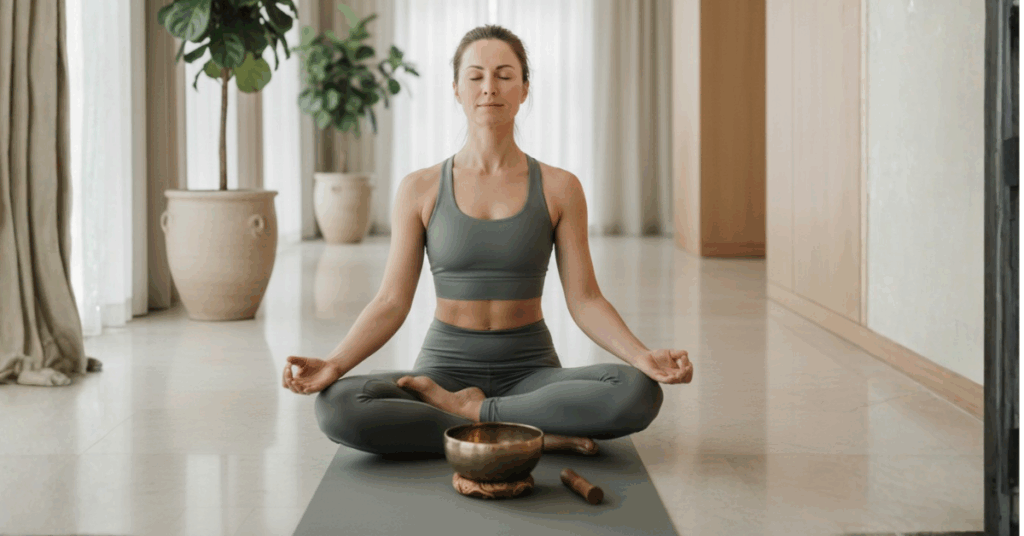
The modern singing bowl meditation practice typically involves participants lying down while a trained facilitator plays multiple singing bowls, along with other instruments like crystal bowls and gongs, for approximately 60 minutes. The experience creates a full-body sound bath that envelops participants in calming frequencies.
The Science Behind Singing Bowl Meditation: How It Works
Brainwave Synchronization and the Relaxation Response
One of the most compelling mechanisms behind singing bowls’ effectiveness lies in their ability to synchronize brainwaves. Research has shown that the sound frequencies produced by singing bowls can influence brain activity patterns, particularly in the theta wave region (4-8 Hz), which is associated with deep relaxation, meditation, and restorative sleep.
A study examining brainwave synchronization found that singing bowl sounds produced up to 251% increases in spectral magnitudes of brain waves at the beat frequency, supporting the hypothesis that singing bowls effectively facilitate meditation and relaxation. When the brain entrains to these frequencies, it naturally shifts into a state of calm alertness, the same state achieved through traditional meditation but without requiring years of practice.
Activation of the Parasympathetic Nervous System
The relaxation response triggered by singing bowls activates the parasympathetic nervous system often called the “rest and digest” system. This counteracts the sympathetic nervous system’s “fight-or-flight” response that becomes overactive during stress and anxiety.
When the parasympathetic nervous system is activated, your body experiences:
- Lowered blood pressure and heart rate
- Reduced cortisol (stress hormone) levels
- Improved digestion
- Enhanced immune function
- Deeper, more restorative sleep
Clinical Research: What Studies Show About Singing Bowl Benefits
Effects on Mood, Tension, and Well-Being
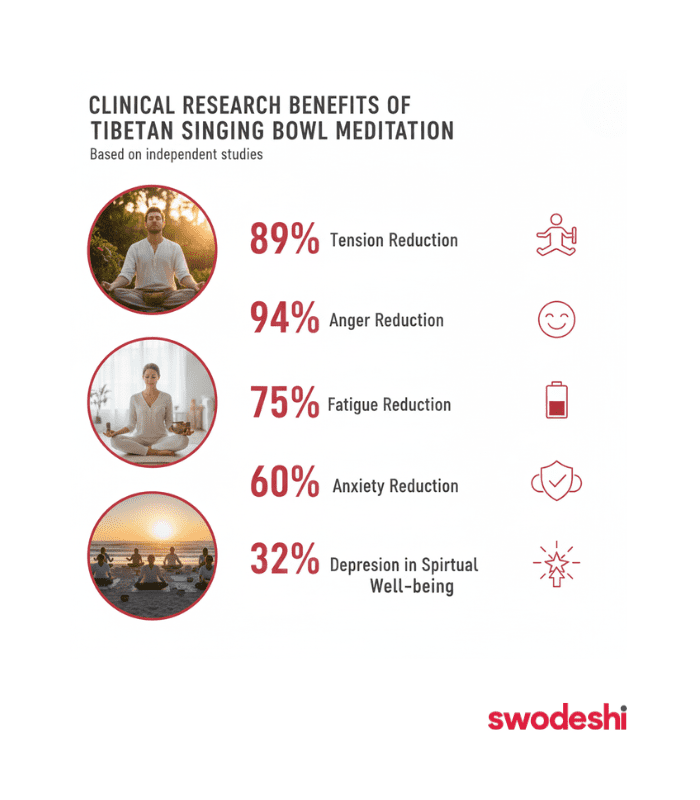
A landmark observational study published in the Journal of Evidence-Based Complementary and Alternative Medicine examined the effects of Tibetan singing bowl meditation on 62 participants. The results were striking:
Key Findings:
- Tension reduction: Participants experienced a 89% reduction in tension (from 1.26 to 0.14 on the measurement scale)
- Anger reduction: 94% decrease in anger levels (from 0.85 to 0.05)
- Fatigue improvement: 75% reduction in fatigue
- Depression relief: 32% decrease in depressed mood
- Anxiety reduction: 60% decrease in anxiety
- Spiritual well-being: 28% increase in feelings of spiritual well-being
All changes were statistically significant at p < 0.001, indicating these were not random results.
Notably, participants who had never experienced singing bowl meditation before (termed “bowl naïve”) showed significantly greater reductions in tension compared to experienced practitioners. This means even your first session can be powerfully effective.
Age-Related Effects
The research revealed interesting age-related patterns. Participants aged 40-59 years demonstrated the most dramatic benefits:
- The largest reduction in physical pain (1.21-point decrease on a 5-point scale)
- Strong reduction in tension, especially among those new to the practice
- Significant improvements in anxiety levels
Younger participants (20-39 years) also showed remarkable benefits, with a 1.35-point decrease in tension—the highest of any age group.
Physical Pain Reduction
Beyond mood improvements, 29 participants reporting physical pain pre-meditation showed significant relief:
- Overall mean pain rating decreased from 1.82 to 0.84
- Participants new to singing bowls experienced the most dramatic pain reduction (from 1.88 to 0.69)
- The effect was consistent across age groups
Anxiety Relief: Singing Bowls vs. Other Relaxation Methods
A recent randomized controlled trial compared the effectiveness of Tibetan singing bowl (TSB) meditation against Progressive Muscle Relaxation (PMR) and a control group. The results showed that a single session of singing bowl treatment induced a more evident psychological and physiological relaxation response compared to both PMR and the control group.
Specific improvements with TSB:
- Greater reductions in self-reported anxiety
- Increased Heart Rate Variability (HRV)—a marker of cardiovascular health and stress resilience
- More pronounced reductions in alpha brain wave power (associated with relaxation)
Conclusion: Why Singing Bowl Meditation Is More Than Just a Trend
Scientific Sources and Further Reading
For those interested in diving deeper into the research, here are the primary scientific sources:
- Goldsby, T. L., Goldsby, M. E., McWalters, M., & Mills, P. J. (2017). Effects of Singing Bowl Sound Meditation on Mood, Tension, and Well-being: An Observational Study. Journal of Evidence-Based Complementary and Alternative Medicine, 22, 401-406.
- Cai, Y., Yang, G., & Liu, Y. (2025). Therapeutic effects of singing bowls: A systematic review of clinical studies. Integrative Medicine Research, 14(2), 101144.